
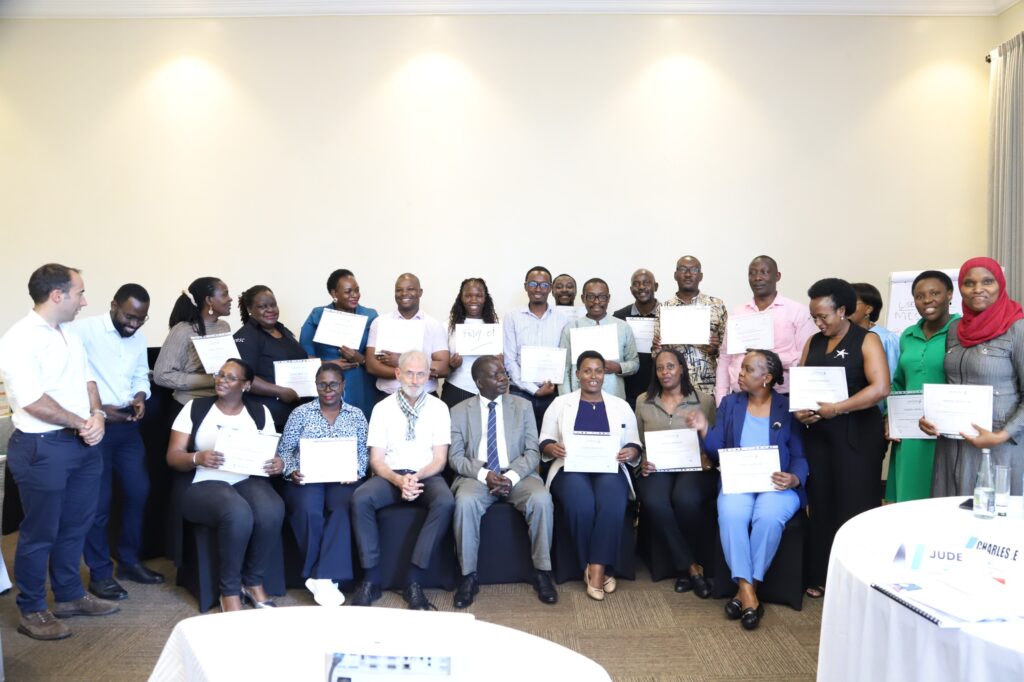
The National Water and Sewerage Corporation (NWSC) has strengthened its executive leadership capacity following the conclusion of a week long training programme on Operative Intelligence, aimed at enhancing strategic decision-making, institutional coordination and operational performance.
The training, held at Mestil Hotel in Kampala, was organised by SUEZ Consulting in collaboration with AgroParisTech and AFD/SUEZ under Package 6E of the Kampala Water–Lake Victoria Water and Sanitation Project (KW-LVWATSAN).
The initiative forms part of NWSC’s broader institutional capacity development efforts, equipping executive managers with practical approaches to strategic leadership, resource optimisation, performance management and effective implementation of corporate objectives.
A central focus of the programme was bridging the gap between strategic planning and operational execution, enabling managers to translate institutional priorities into measurable results while responding effectively to emerging challenges.
Through interactive discussions, practical exercises and group-based learning, participants explored approaches to managing competing institutional demands, strengthening cross-departmental collaboration and aligning operational activities with NWSC’s long term strategic objectives.
The programme further emphasised evidence based decision making, organisational adaptability and the integration of measurable Key Performance Indicators (KPIs) into strategic planning and implementation.
Presiding over the closing ceremony, the Deputy Managing Director Technical Services, Eng. Johnson Amayo, challenged executive managers to move beyond developing strategic plans and focus on translating them into coordinated action and measurable institutional results.
He emphasised the importance of critical thinking, strategic partnerships and emotional intelligence in navigating complex operational environments and strengthening organisational performance.
Drawing parallels between military strategic planning and corporate leadership, Eng. Amayo highlighted the importance of establishing clear objectives, identifying potential risks and defining desired outcomes before implementing strategic interventions.
He challenged participants to consistently evaluate their operational environments, identify relevant stakeholders and develop practical approaches to achieving institutional objectives within short, medium and long term planning horizons.
Eng. Amayo further commended the programme facilitator, Lt. Gen. Emmanuel de Romémont, for introducing practical strategic planning approaches and encouraged participants to cascade the knowledge acquired to their respective teams.
He also underscored the need to strengthen conflict management and emotional intelligence competencies as complementary aspects of effective institutional leadership.

Facilitating the programme, Lt. Gen. Emmanuel de Romémont emphasised the importance of consistency, adaptability and disciplined execution in achieving strategic objectives.
He commended participants for their commitment throughout the training and challenged them to apply the acquired competencies in their respective areas of responsibility.
The programme encouraged executive managers to adopt a more integrated approach to leadership, recognising the relationship between departmental performance, institutional priorities and overall service delivery outcomes.
Particular emphasis was placed on breaking down departmental silos, promoting collective ownership of corporate objectives and ensuring that institutional resources contribute directly to operational efficiency and business performance.
Participants welcomed the training as an opportunity to strengthen their strategic leadership capabilities and explore innovative approaches to addressing operational challenges.
Annette Kukunda, Senior Manager CBD, highlighted the programme’s contribution to strengthening her ability to anticipate operational challenges and develop forward-looking management strategies.
Chief Eng. Andrew Muhwezi appreciated the practical role-playing exercises, noting that they provided valuable insights into developing strategic guidance and applying structured decision-making approaches in professional responsibilities.
Dr. Frank Kizito emphasised the importance of beginning strategic planning with clearly defined outcomes while maintaining the flexibility required to respond to changing operational circumstances.
Joyce Bakire, Senior Manager Training and Capacity Development, highlighted the programme’s emphasis on creativity, innovation, collaboration and problem-solving as essential competencies for effective leadership.
Denis Taremwa, a Director at NWSC, observed that the training had encouraged participants to rethink conventional approaches to strategic planning, including the application and evaluation of institutional performance indicators.
Similarly, Gloria Basemera, General Manager Entebbe, emphasised the importance of balancing strategic ambitions with operational realities to ensure that institutional objectives translate into practical achievements.
Eng. Zainab Mpakiraba appreciated NWSC Management for facilitating the training, noting that the programme had strengthened her ability to develop concise, deliberate and actionable strategies that could be shared and implemented within her team.
Other participants highlighted the importance of collaborative leadership, critical thinking, effective resource utilisation and continuous performance evaluation in strengthening institutional effectiveness.
The Operative Intelligence training reinforces NWSC’s commitment to continuous professional development and strengthening leadership competencies across the Corporation.
By equipping executive managers with practical strategic planning and implementation skills, the programme is expected to contribute to improved institutional coordination, more effective resource deployment and stronger accountability for operational results.
The training also underscores the importance of aligning corporate strategy with day-to-day operational decisions, ensuring that institutional priorities are reflected in measurable improvements across NWSC’s service delivery functions.
Ultimately, the value of the initiative will be demonstrated through its practical application in strengthening operational efficiency, customer satisfaction, financial sustainability and the delivery of reliable water and sanitation services.