As Africa continues to grapple with lack of access to clean water and sanitation, we are reminded of a reality that is as urgent as it is unjust: the global water crisis does not discriminate. It impacts men, women, families, communities, and children. This demands a response that is inclusive of everyone.
Placing every voice of women, men, girls, and boys at the center of water management, governance, and leadership is equally important if we are serious about ensuring that everyone has fair access to water. Women are vital to Uganda’s economy, owning several SMEs and micro enterprises across the country.
At home, women typically carry out most of the unpaid domestic and caregiving tasks, which include water-intensive responsibilities essential for maintaining family health. These tasks involve sourcing and purchasing water, storing it safely, and ensuring it is safe to drink. In communities lacking a reliable water supply, some women have reported waiting anywhere from 20 minutes to a full day to access safe drinking water from public water sources. This significant waiting time could otherwise be invested in economic activities or educational opportunities for children.
Together, these realities point to an overlooked opportunity: when water services work better for women and when women can access jobs in the sector the gains extend well beyond households to productivity, enterprise growth, and local economies.
The good news however is that NWSC is taking a leading role in advancing gender inclusivity with women taking up different decision-making positions on the board and top management. Gender equity and inclusiveness remain central to NWSC’s human resource strategy.
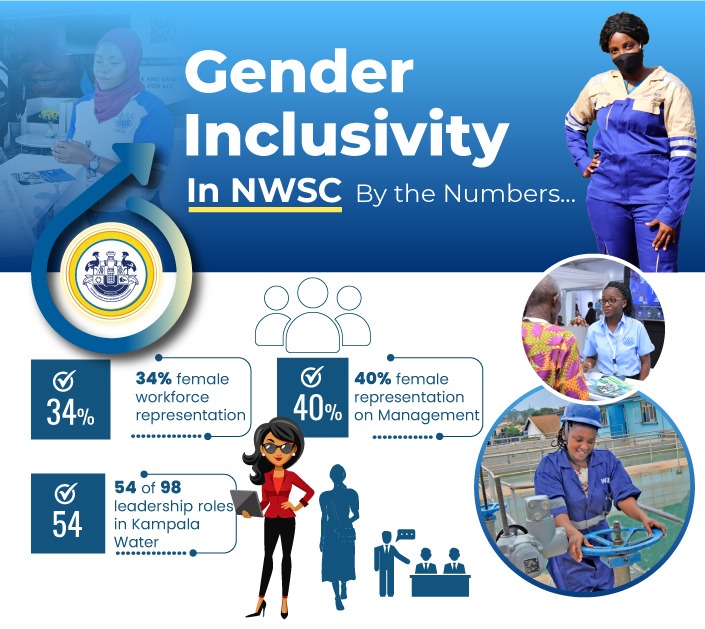
Women account for 34% of the workforce and 40% of management roles. As a major employer in Uganda’s public utility sector, NWSC provides direct employment to over 4,600 staff.
Women are also represented in various technical jobs across different sectors, including Engineering and Technical Services, Procurement, Legal and Management Services, Business and Scientific Services, and Human Resources, among others. At NWSC, women are actively involved in roles related to water quality management, plumbing, and engineering fields that are often considered male-dominated.
The hiring process is designed to be gender-inclusive and provides equal opportunities for all candidates, including women. NWSC actively eliminates bias at every stage of recruitment, from job descriptions to onboarding. It ensures that all candidates are evaluated based solely on their skills and qualifications, regardless of their gender identity.
A number of women were also beneficiaries of the recently concluded Worker’s PAS graduation. Marking yet another important milestone in NWSC’s deliberate effort to strengthen human capital and build a competent, resilient, and future-ready workforce.
The Corporation has updated its Human Resource Manual to institutionalize gender responsiveness and foster a culture of diversity and equal opportunity affirming its alignment with national gender mainstreaming objectives and its leadership in inclusive workplace practices. It is also worth noting that the NWSC Human Resources Manual clearly safeguards women against harassment or discrimination.
NWSC has also rolled out the Empower Her Mentorship and Leadership Program, launched earlier this year in March, seeking to nurture and empower women professionals within the water and sanitation sector through leadership development, mentorship, and continuous learning. The initiative is being implemented under the Professional Women for Water and Sanitation Network (P4WATSAN), a women-focused platform operating under the African Water and Sanitation Association (AfWASA).
To advance equitable service delivery, NWSC continues to roll out the SCAP 100 Project, targeting underserved communities through the installation of public standpipes and subsidized pro-poor connections. This initiative contributes to the goal of universal access to safe water, enhances public health, and narrows the rural-urban service gap.