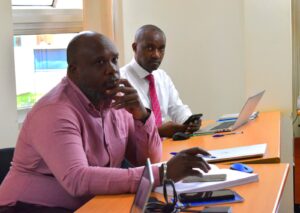
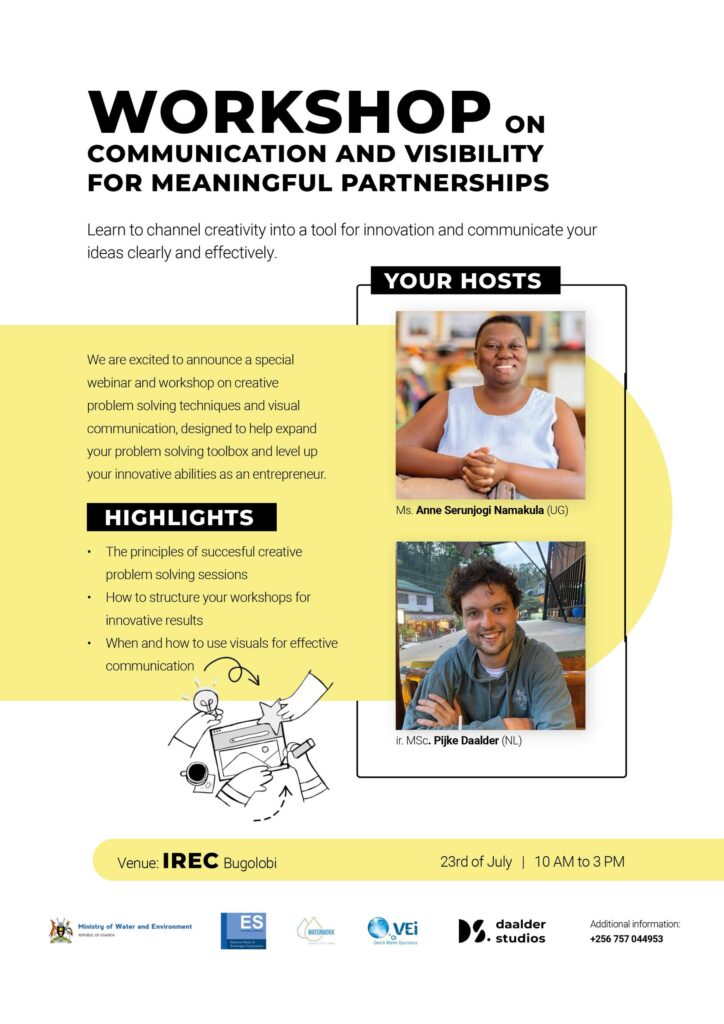
On a quiet Thursday morning at IREC Bugolobi, the usual hum of office activity gave way to a more intentional energy. It was the sound of reflection, collaboration, and quiet breakthroughs as participants from six regional utilities came together for a unique workshop on Communication and Visibility for Meaningful Partnerships.
Organised under the WaterWorX programme by VEI and hosted by the National Water and Sewerage Corporation (NWSC) External Services Unit, the workshop attracted participants from across the country, as well as key partners from the Ministry of Water and Environment. But more than just another training on communication, this was a session that peeled back the layers of what it truly means to inform, engage, and inspire through creative expression.
The facilitators, Anne Serunjogi Namakula and Pijke Daalder, steered the session with clarity and conviction, inviting participants to dig deeper into how they communicate in their daily roles. In a space where many are accustomed to formal reports, letters, and reactive messaging, the workshop opened up a conversation about strategy, simplicity, and storytelling.
The opening exercise was disarmingly simple: describe your job using a drawing. For many in the room, the challenge wasn’t in finding the words it was in letting go of them.
Participants were asked to explain their profession using only visuals before adding text, forcing them to consider how clearly their message would land if language weren’t an option.
The result was a mix of stick figures, pipes, laptops, and water droplets each one telling a story that, in its rawness, felt closer to the truth.
The day unfolded with sessions that built upon this creative foundation. Participants were introduced to the structure of effective communication, from identifying the real problem to generating ideas and mapping out solutions. The facilitators emphasised that good ideas do not always arrive fully formed; rather, they emerge through exploration, iteration, and openness to failure.
One of the more profound takeaways was the visualisation of the creative process as a fishbone like diagram, an image that depicted how ideas diverge and converge. This process, the facilitators explained, is where clarity is found. It is where the message becomes refined, and where communication begins to serve its purpose rather than simply fill space.
Throughout the workshop, the underlying message remained consistent: communication is not about making noise, but about making meaning. And making meaning requires more than just information; it demands empathy, clarity, and a willingness to be understood.
In an era where organisations are increasingly expected to communicate across multiple platforms, the workshop reminded participants that sophisticated tools are not what make communication effective. Rather, it is the ability to step back, simplify, and connect with an audience that matters most.
As the session drew to a close, there was a quiet shift in the room and acknowledgement that something essential had been recalibrated. For many, it was the first time they had been asked to reflect so deeply on how they communicate, and why.
The workshop was more than a learning session. It was a reminder that every role in the water and sanitation sector tells a story. And the way those stories are told whether through a social media post, a field report, or a drawing on a piece of paper matters.
With renewed energy, participants left not just with new tools, but with a deeper understanding of their responsibility as storytellers. Because in the end, the work they do is not just technical. It is human. And the stories they tell shape the way the world sees the work and values it.