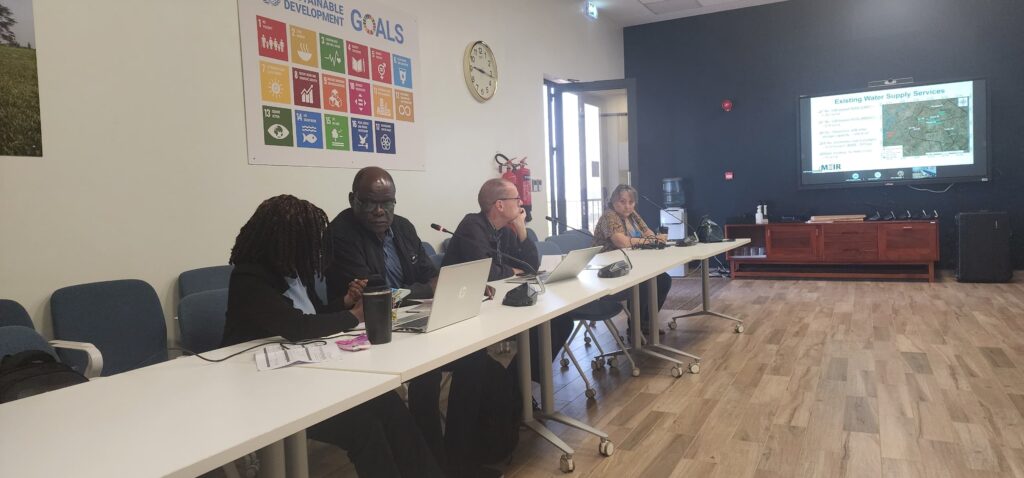
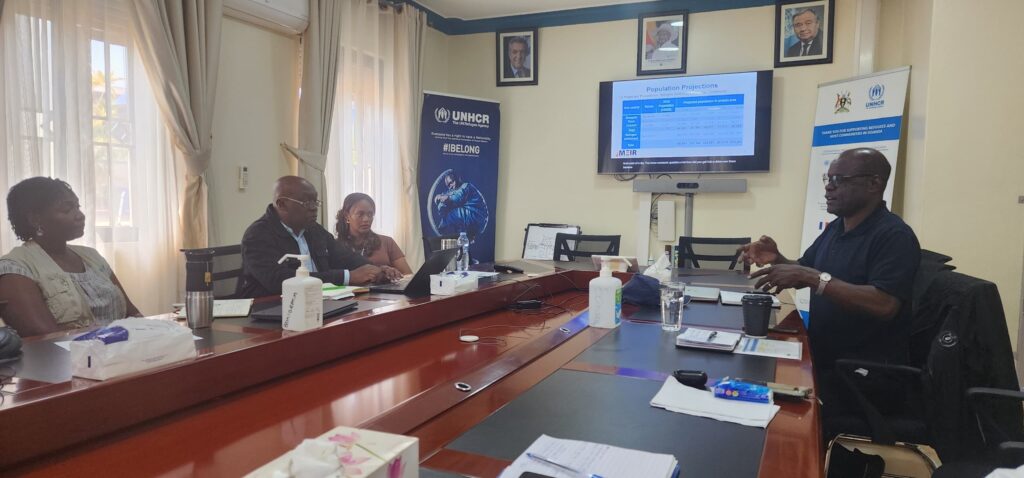
The latest feasibility study for improving water supply in the Kiryandongo Refugee Settlement was presented by MEIR Engineering and Research Limited during a high-level meeting at UNICEF offices in Mbuya on June 27th, 2025. The session drew participants from UNHCR, UNICEF, the Office of the Prime Minister, Lutheran World Federation (LWF), ECHO, the Ministry of Water and Environment, KfW, the European Union, and National Water and Sewerage Corporation (NWSC). This followed a pre-briefing at the UNHCR field offices in Kiryandongo.
The revised report responds to persistent water challenges facing more than 137,000 refugees and their host communities. It also reflects adjustments informed by feedback on the initial version shared in April and includes sharper data, expanded scope, and a clearer focus on the needs of both refugees and Ugandan residents.
To start, the updated demand assessment sets current daily water needs at 4,671 cubic meters, a significant jump from the 3,775 m³/day originally reported. With projections rising to 5,876 m³/day by 2044, the current supply of just under 1,900 m³/day, sourced from seven borehole systems and NWSC’s piped water, leaves a large gap. Water trucking from River Siriba continues to act as a temporary stopgap, supplying only 70 m³/day.
MEIR laid out a phased plan to bridge the gap, starting with two solar-powered groundwater systems at DWD 63884 and DWD 63863. Estimated at UGX 2.03 billion, these systems are expected to immediately relieve pressure on existing sources and increase safe water coverage.
With a budget standing at UGX 14 billion, the medium-term strategy introduces six new boreholes, expansion of the Gaspa RGC supply system, and a centralized treatment plant with a capacity of 551.6 m³/day. This would help manage contamination concerns, particularly high levels of iron, sodium, and phosphates in the groundwater.
For the longer term, the study compares two large-scale surface water options. One would extend the Karuma Water Treatment Plant to supply 10,000 m³/day at UGX 109.4 billion. The other, drawing water directly from River Siriba, would support a much higher yield of 24,726 m³/day at a lower estimated cost of UGX 69.8 billion. MEIR’s analysis favors the Siriba option for its reliability, better water quality, and lower capital input since other options, including abstraction from Masindi Port or Lwalagada, were found to be more expensive and less practical.
The report also presents improved treatment approaches for both groundwater and surface water. Aeration, sedimentation, ion exchange, and chlorination are recommended for boreholes, while conventional treatment processes such as flocculation will be used for river sources. Storage and distribution upgrades include an additional 80 km of network and five new reservoirs, each holding 1,000 m³, to reinforce the current 452 m³ storage capacity.
To manage operational costs, solar power has been proposed as a backup to grid electricity, reducing reliance on diesel generators.
During the meeting, NWSC’s Joseph Mulinde shared lessons from the Rwamwanja Refugee Settlement transition in 2020. At the time, NWSC assumed control of a system that was still underdeveloped, and the result was higher operational costs, low borehole yields, and equipment failures triggered by unstable power and generator use. Therefore, Mulinde recommended the inclusion of voltage stabilizers in short-term installations to protect pumps and motors from burnout, a costly issue experienced in Rwamwanja. In response, MEIR confirmed the designs would be updated to reflect this recommendation.
Mr. Mulinde also pointed to the long-term financial burden of generator dependency, noting that investing in grid extensions would save millions over time, money currently spent on fuel and maintenance.
These financial considerations are further reinforced by data in the report, which integrates findings from the 2024 REACH Multi-Sectoral Needs Assessment. It shows that 89% of refugee households and 71% of host communities rely on basic water services, mostly public taps and hand pumps. Meanwhile, average monthly spending on water ranges between UGX 7,700 and UGX 8,000, which points to a strong willingness, and ability, to pay for improved services. However, stakeholders requested clarity on potential costs to communities along the transmission lines, asking that this be addressed in the final submission.
By the end of the session, there was growing support for accelerating the short-term groundwater interventions, particularly in severely affected areas like Cluster B. Partners called for a clear implementation roadmap and urged close coordination as surface water designs move ahead. NWSC recapped its support for the initiative and called for the development of robust maintenance structures that would protect infrastructure and ensure continuity of service in the years ahead.
Get started instantly—earn on every referral you make! https://shorturl.fm/zcutf
Join our affiliate community and earn more—register now! https://shorturl.fm/tN5qK
Monetize your influence—become an affiliate today! https://shorturl.fm/EYr8e
Earn passive income this month—become an affiliate partner and get paid! https://shorturl.fm/7kWGT
Get paid for every click—join our affiliate network now! https://shorturl.fm/PKn0l
Partner with us for generous payouts—sign up today! https://shorturl.fm/fUMrx
Share our offers and watch your wallet grow—become an affiliate! https://shorturl.fm/yQ0vD
Monetize your audience—become an affiliate partner now! https://shorturl.fm/2hezE
Share our offers and watch your wallet grow—become an affiliate! https://shorturl.fm/FWwes
Start earning passive income—become our affiliate partner! https://shorturl.fm/nO6gh
Monetize your influence—become an affiliate today! https://shorturl.fm/BDX73
Share your link and rake in rewards—join our affiliate team! https://shorturl.fm/8N5Rs
Unlock exclusive rewards with every referral—enroll now! https://shorturl.fm/9GEOf
Join our affiliate program and start earning today—sign up now! https://shorturl.fm/gu5Ik
Turn referrals into revenue—sign up for our affiliate program today! https://shorturl.fm/FILDf
Monetize your influence—become an affiliate today! https://shorturl.fm/NPvW3
Start earning passive income—become our affiliate partner! https://shorturl.fm/buVG2
Promote our brand and get paid—enroll in our affiliate program! https://shorturl.fm/SKzZ1
Earn recurring commissions with each referral—enroll today! https://shorturl.fm/wUmT9
8ku, eh? Heard some rumblings about it but haven’t checked it out myself yet. Anyone using 8ku? What’s the vibe?
Hey guys, just tried out fortunesnakebr and gotta say, it’s pretty rad! Smooth interface and the gameplay is on point. Definitely worth checking out if you’re looking for something new. Check it out here: fortunesnakebr
Followin’ olabahistwitter for the latest updates? Gotta stay in the loop with those promo codes, am I right? Good luck out there, playas!